AI writes the code.Can your candidate judge it?
Kodin assesses your candidates from four angles: arbitrating a code review done by an AI, designing a system under load and budget constraints, holding the on-call shift of a struggling system with their AI tool, then defending their choices against questions generated from their work and background.
- 1,500 requests/s, ×1.5 spike for 3 min met
- p95 latency ≤ 300 ms met
- Error rate ≤ 1% not met during the spike
- Monthly cost ≤ €6,000 met (€5,420)
Then replayed against incidents the candidate never saw.
- Outage: The API fails one request in six since T+12 min
- Slowdown: The Database responds 9 times slower since T+9 min
- Delivery: 2 tickets pending deadline T+24 min
Cohort of 6 candidates: everyone sees the others' scores, never their decisions.
- You put a message queue in front of the payment database. What does the customer experience if it saturates during the spike?
- Your résumé mentions a migration to Kubernetes. With hindsight, what would you have done differently here?
A take-home solved by an AI tells you nothing about the candidate.
Much of today's code is written with AI. Technical tests still grade the ability to write it. You get a clean submission that says little about the person's judgment, then extra interviews to make up for it.
Four angles on the same candidate.
Arbitrate an AI review.
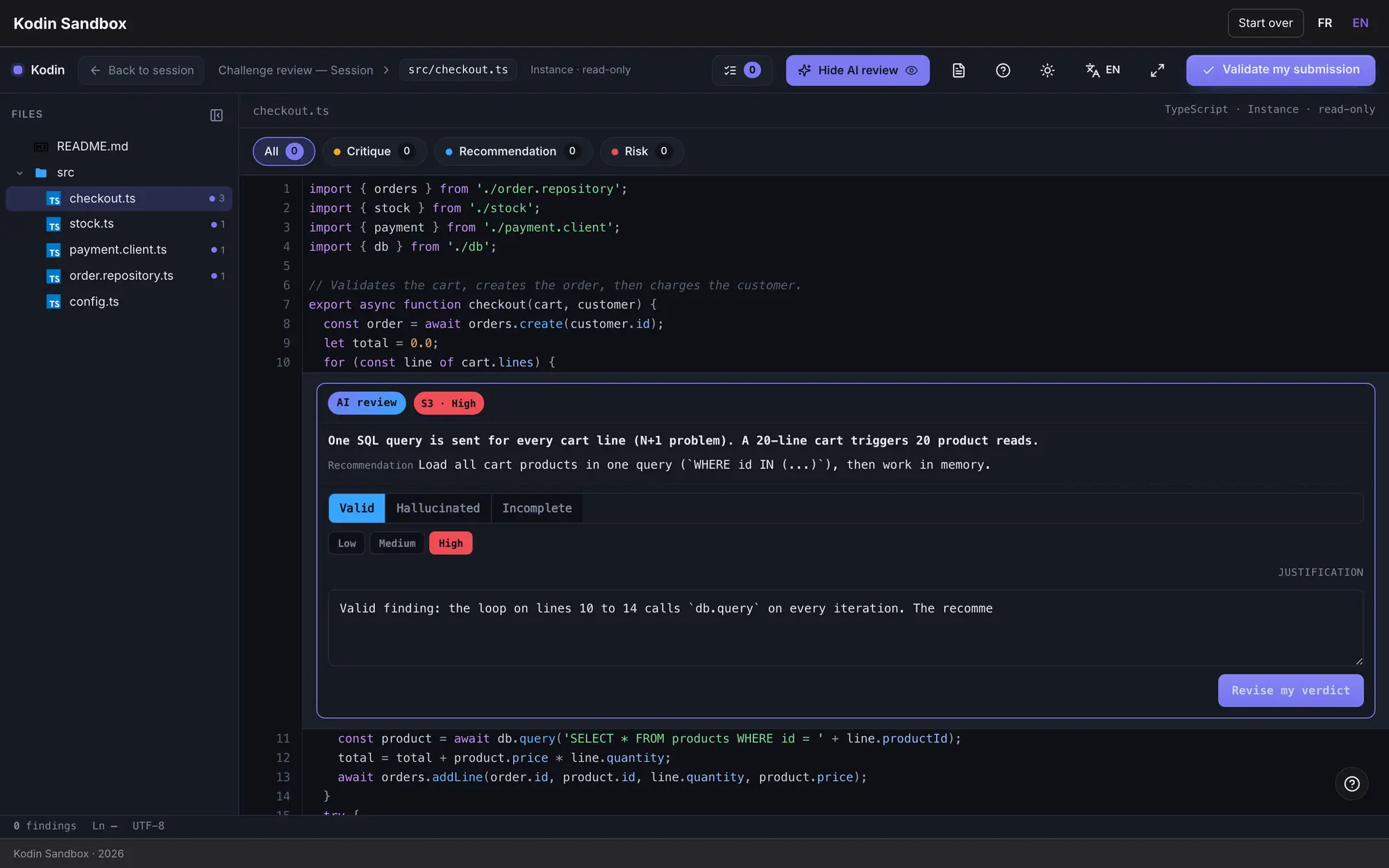
The candidate gets code along with the review an AI made of it, deliberately imperfect. For each finding, they decide: valid, incomplete or hallucinated, and justify it. Then they add what the AI missed.
Design a system under real constraints.
They get a business case with hard numbers: volume, load spikes, latency, error rate and monthly budget. They assemble their architecture, simulate it against the load and justify their trade-offs. On submission, Kodin replays it against incidents they haven't seen.
Hold the on-call shift, as a cohort.
Game Day hands them a small system for 15 to 60 minutes. An outage, a slowdown and tickets with deadlines compete for their time. They work in a real repository with their AI tool, and every commit they push is judged by hidden tests. The whole cohort plays the same scenario.
Defend their work.
Kodin generates questions from what they just produced and from their résumé, then adapts them to their answers. They have to explain their choices, and how well this fits their background becomes visible.
Each angle produces its own score. Together, they show how the candidate reasons when AI does part of the work.
Game Day: hold the on-call shift, as a cohort.
The candidate takes charge of a small system for 15, 30, 45 or 60 minutes. An outage, a slowdown and promised tickets compete for their time, and they won't get to everything: the exercise measures how they arbitrate. They work in a real Git repository with their AI tool, and every commit they push makes the board react. The whole cohort plays the same scenario and everyone sees the others' scores, never their decisions.
- Score
- 712
- Rank
- 2nd of 6
- Availability
- 96.4%
- Customer trust
- 78
- Value delivered
- 9 / 25
- Game time
- T+18 min / 30
- Gateway13%142 ms
- API16%118 ms
- Auth0.4%31 ms
- Database0.6%189 ms
- Cache0.5%3 ms
-
c04d2e1 fix(api): clear the session cachefix had no effect -
7be2104 feat(kdn-104): export readingsticket delivered -
a1f3c97 fix(db): enlarge the poolbuild failed
KDN-105Cold-chain break alertbefore T+24 minKDN-106Filter routes by warehousebefore T+29 min
- 1Player 14768
- 2You712
- 3Player 52655
- 4Player 07640
- 5Player 31590
- 6Player 88512
A Kodin assessment, in four steps.
-
You describe the role.
Job description, request for proposal or résumé: Kodin generates the exercises for your stack and at the target level.
-
The candidate takes the exercises.
AI review, architecture design, then questions generated from their work and profile.
-
Grading and debrief.
Review verdicts and architecture requirements are checked automatically. Justifications and answers are assessed, then discussed with a mentor.
-
You get the report.
A score per angle, comparable from one candidate to the next, and the points to dig into during the interview.
Two rates computed on every decision.
Detection rate
The share of the AI's errors the candidate catches: false findings they reject and omissions they recover.
Acceptance rate
The share of false findings they accept because the AI states them with confidence.
Example: the review contains 6 findings, 2 of them false, and the AI missed 1 issue. The candidate rejects one false finding, accepts the other and recovers the omission: 67% detection, 50% acceptance.
What you receive after each session.
- AI review: each verdict with its justification, both rates, issues found off the list.
- Architecture: requirements met or not, scenario by scenario, hidden incidents included, the monthly cost achieved and the justified trade-offs.
- Game Day: the score out of 1,000, the rank in the cohort, the decision profile and the timeline of actions and commits.
- Questions: the key answers, and the gaps between what the candidate says and what they did.
- Mentor summary: a score per angle, and the points to dig into during the interview.
A subscription that fits your hiring volume.
A full assessment costs 15 tokens. One month free with any annual commitment.
Free trial: 15 tokens on us, enough for one full assessment. No credit card.
Get started125 tokens per month, or 8 assessments.
About €9.50 per assessmentAbout €8.70 per assessment
Choose350 tokens per month, or 23 assessments.
About €6.80 per assessmentAbout €6.25 per assessment
Choose900 tokens per month, or 60 assessments.
About €5.50 per assessmentAbout €5.05 per assessment
ChooseVolumes beyond 60 assessments per month, deployment on your infrastructure, API and white label.
Request a quoteA full assessment includes the AI review, the architecture exercise, the questions, the debrief and the report.
Frequently asked questions
How is Kodin different from a classic coding test?
The candidate doesn't churn out code. They judge a review done by an AI, design an architecture under constraints and answer questions about their own work. Kodin assesses how sound their decisions are and the quality of their arguments.
Can a candidate cheat with an AI?
They can ask an AI for its opinion. Yet the review is precisely about judging an AI, the architecture is replayed against incidents they can't see, and the questions focus on their own answers and background. Having an outside tool produce everything becomes slow and inconsistent. No test is tamper-proof: this format makes cheating costlier and more visible.
Which roles and languages?
Development, infrastructure and cloud, data, quality and security. The exercises are generated for the role's stack. See the full list
What happens to the hiring decision under the AI Act?
The AI Act classifies candidate assessment tools as high-risk uses. Kodin produces a report. The hiring decision always rests with a recruiter on your team, who can review every verdict and its justification. The candidate can request a human review of their assessment. Hosting can be on your own infrastructure. Our AI Act and data page
What does the candidate see?
They know the exercise format in advance and can request deletion of their data.
Can I change plans or cancel?
Yes. The monthly subscription can be changed or stopped at any time; the annual commitment runs for 12 months.
Try Kodin on a role you have open.
Create your organization: your first full assessment is free.